
A story about how opinion - a human, free, and ordinary thing by nature - was locked, within a single generation, inside other people’s databases, fenced in by terms of service, and made dependent on the grace of platform operators. And also about what a swarm of Orbiplex nodes could change in a world where an opinion belongs to the one who voiced it, not to the one who holds the disk (and the profit).
Three Short Stories
The Cameraman and Polgrzybix
Matthew is a film editor who, after retiring, turned a kind of quiet civic watch into his hobby: he rides his bicycle around the outskirts of the city, films pipes, chimneys, sewer outlets, coal-stained hands of people seasoned by life in municipal tenements, and then publishes short reports about things the local environmental protection office would prefer to see less clearly. He has good equipment and knows the law, because for two years he edited reports for local television and learned that, in Poland, filming an object from a public road is legal as long as one does not violate the privacy of other people’s yards.
One Wednesday (and it was Ash Wednesday), he stood by the fence of the Polgrzybix plant, which had been producing antifungal foot cream for thirty years and, for twenty, had been discharging into a local ditch something that looked like cloudy, whitish water with a smell difficult to describe in polite words.

Matthew filmed calmly from the roadside, without entering the plant grounds. He was not in anyone’s way. After about twenty minutes, a police car pulled up beside him, and two officers stepped out, slightly embarrassed by their own role. The identity check lasted longer than it should have. There were suggestions that “the president reported it and asked us to check”, that “this is a strategic facility”, that “it would be good to delete the material”. Matthew did not delete it. He demanded the legal basis, wrote down their badge numbers, and went to a lawyer that evening.
Half a year later, the court stated clearly that the identity check had taken place without legal basis and unlawfully, and that the attempt to influence the content of the material was an abuse of authority. Matthew won, received compensation, and got something more important: a final judgment he could show to others. So he wanted to do the natural thing - leave an opinion on the website of the police station where, that day, the decision to send the patrol car had been made. It was not a denunciation or a manifesto, but a few sentences and a hypertext link to the case number: “That day, at this station, this decision. The court found it unlawful. It is worth knowing.” He opened the website and saw that comments were disabled, while the contact form led into a void.
That is exactly the moment when an opinion - a thing as ordinary as a conversation by the fence - is blown away before it can arrange itself into words visible to anyone besides its author. Matthew could not voice it where it would be noticed, because the owner of the resource (the police station website) had not provided a place for a citizen’s voice, and nobody else had the right to open such a place on his behalf.
The Laundry Detergent That Bit the Skin
Yolanda bought a laundry detergent on a well-known auction site, and after a single wash cycle it left red, burning patches on her shoulders and neck. It looked like an allergic reaction, so, like any person shaped by an analytical culture, she went looking for information.

She checked the EAN code on the package, then the composition, and then the European database of chemical substances in consumer products. Eventually she reached information that worried her: one of the ingredients was permitted in the European Union only at a concentration not exceeding a few hundredths of a percent, while here, according to the composition found in the specification, it appeared at a significantly higher concentration. A dermatologist confirmed that Yolanda’s skin had probably reacted to that very ingredient, and a toxicologist from a university forum added that such non-compliance with an EU standard should result in the batch being withdrawn.
So Yola returned to the auction site and wrote a reliable review under the product page. She described the symptom, the composition check, named the substance, and gave both the declared and the permitted concentration. At the end she added a warning for people with sensitive skin and noted that she had no intention of slandering anyone, but wanted other buyers to know what they were dealing with. The opinion stayed up for thirty-seven minutes. It was removed with the justification: “unfair competition”. Yolanda was not competition - the only things she had ever sold on that site were two boxes of perfume from her student years. She filed an appeal and received a form. She filled in the form and received feedback saying that the decision was final.
And so an honest, well-substantiated opinion by a buyer was deleted not because it was false, but because it threatened the business relationship between the service operator and the seller who pays it commission. In a world where a product opinion is stored in the database of the seller or intermediary, deleting it is as simple as deleting a file. And nobody except the author, who remembers it, knows that it ever existed.
Ten Years of Loyalty
Miroslav had been an active user of a social service where people shared links to articles, columns, and essays worth reading. Over that time he added more than eight thousand links, gathered a small, steady group of readers around him, and wrote short introductory comments - sometimes polemical, sometimes ironic, but always civil.
The team managing the service changed last year, and with it the tone changed: a new, unwritten editorial line appeared, one for which certain topics were out of place.
Miro did not change his style, did not violate the rules, did not insult people, but he also did not stop linking to texts that did not agree with the new program line of the operator, who could sometimes be regarded as a publisher.
In February he received a warning, in March a one-day block, and in May, without any explanation beyond a perfunctory formula, his access to the account was permanently blocked. Along with the account, he lost access to thousands of links, hundreds of comments, and ten years of relationships with people he knew only by pseudonyms. He wrote to the administrators, but received a polite answer of the “the decision is final” kind. On a forum of another service, in turn, he learned that he was not the first, because for several months the moderation team had been deleting accounts of those whose views it considered inappropriate, regardless of seniority and behavior.
Our protagonist did not quarrel with the network or with people. He quarreled with the owner of access to a resource, one that was moreover based on content supplied by users. And because this was a resource, that is, someone’s property, not culture, his presence was erased with a single click.
The Feudal Web
The Man Who Climbs Through the Window
All three stories have the same shape: someone has something true and well-grounded to say, but has no place of their own in which they could say it. So they must use someone else’s place. That borrowed place has terms of service, a moderation policy, a business interest, an ownership group, and often also - what matters most in this story - full control over the visibility of speech.
In such a network, an opinion is not an act of speech, but a record in the operator’s database. And a record in someone else’s database is always someone’s property and someone’s decision. It can be deleted, changed, or never shown at all; it can also be restricted to selected readers, and finally - as most often happens - the form can simply be disabled so that it never comes into being. This is freedom of speech on condition of obtaining permission from someone bound by a relationship of dependence to the thing being commented on or evaluated.
For clarity, imagine a situation from life. Let us assume that I bought a defective phone. I am standing with my neighbor on the sidewalk in front of the shop where I bought that phone yesterday. I tell her what happened: that the battery lasts three hours, the screen flickers, and they refused to accept the return.
Suddenly a window opens, and through it the seller briskly climbs out, walks over to us, and says:
Please do not say that here,
this is next to m y shop,
and you are not paying me for the right to have an opinion.
A more cringe-worthy version of the same scene would be a conversation about the product over dinner in one’s own home, with the seller appearing on the other side of the balcony door.
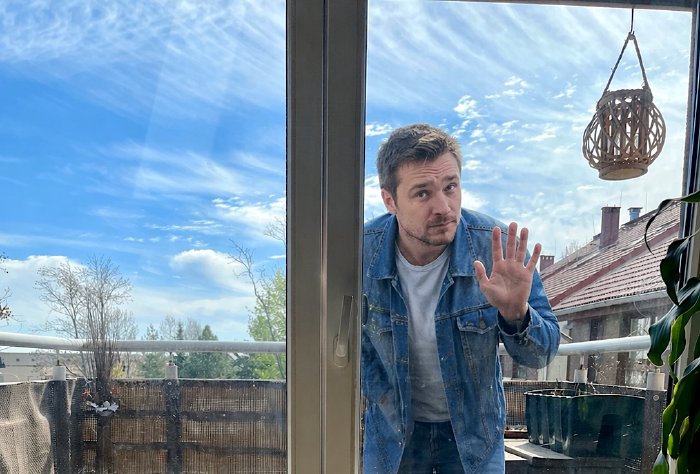
We would, quite rightly, regard such behavior as absurd, scandalous, and perhaps even requiring the intervention of a mental-health specialist. But on the Internet, we accept the equivalent of this scene every day.
We accept it because we have identified an opinion about something with the location of that something. We have managed to believe that talking about a phone next to the shop is something different from talking about that same phone on that same shop’s website. It is not. It is the same conversation, taking place in the same social role, between the same people, and concerning the same event. The medium differs, and in a healthy culture the medium should not take away a person’s right to speak.
One may say that there are more recipients on the network, and therefore it is not the same thing. In my view, this is a slight confusion of problems. Scale of reception is not something new, after all, and it has never been an argument for silencing the speaker. The printing press, radio and television, the daily newspaper - for centuries they had many recipients. One author, and a million readers or viewers. The answer of legal culture was not to deprive the author of the right to express an opinion, but to make the author responsible for truth. Press law, civil law, provisions protecting image and personal rights, and finally codified criminal liability for defamation came into being.
Besides, the shopkeeper in the earlier analogy is not, after all, a single shopkeeper, but a team responsible for shaping the message: both among actual publishers disguised as so-called social media operators, and among sellers. Fear of scale is usually fear of revealing the truth pretending to be concern for order.
Historical Background
When we recall what opinion looks like in civilizational terms, we can see that the mechanisms of surrendering control over it and binding it to a place are a rather young and temporary anomaly, tied to the commercial character of contemporary media, including the Internet and the platforms operating within it.
We can also look at the problem a little more deeply and, in the spirit of apophatic enactivism, notice that in the primary order there is no opinion as an object - there is speaking in relation to some concept or process. Opinion as a thing appears only as a secondary concretization of that event of action: a signature, record, index, quotation, document, file.
Consequently, the right to an opinion belongs to its emitter, but the opinion itself is not anyone’s property in the sense of substance; it is the emitter’s signed trace of participation in the world. This is subtler than classical proprietary thinking. To put it bluntly: I do not “have an opinion” as I have an object; rather, “I speak”, and the system should not appropriate the trace of my speech.
Some time ago, thanks to an invitation from Dr. Krzysztof Popiński, when I was giving guest lectures at the Wroclaw University of Economics, I showed students a timeline on which content in human culture gradually frees itself from successive “packages”.
First, there appears freedom from the carrier: a manuscript could be copied, a book transcribed, and a song notated - in this way the same meaning could live in many copies rather than in one object. Then content freed itself from the human producer: the invention of print shifted the burden from the calligrapher to anyone who had a press and paper, and later to anyone who had a computer and a printer. Then it broke out of enclosure inside the publisher’s process: blogs, forums, and thematic services run by enthusiasts meant that an author no longer had to ask an editorial office for permission to be published and read.
This transition is a historical fact - long and paid for with political and economic struggles - but it is also unfinished. Several layers still remain, including the current one, which has spent almost the last two decades quietly absorbing the others: the platform operator. We have managed to see pluralism in action - there are masses of services with user-generated content, but de facto not under the control of those users.
It is the operator who decides today whose opinion will be displayed, whose account will be active, whose comment will be hidden, and whose court judgment will be linked.
Freeing content from the platform operator is, in my view, the natural next step of the same process. And this is not a political or ideological dream, but a technical and cultural one, rooted in the same impulse that once made it possible to copy a manuscript, start a printing press, and later set up a blog on one’s own hosting.
The Swarm and the Opinion
I imagine a world in which the swarm of Orbiplex nodes begins to be visible as ordinary infrastructure, and opinion stops being an entry in anyone’s database, becoming instead something portable by nature, signed, and recognizable - regardless of where it currently is.
The mechanism on which all this stands is surprisingly small: an opinion refers to a
resource, and the resource is described by a pair: class (resource/kind) and
identifier (resource/id). The class says whether this is a website, a product
described by an EAN code, a book, a place, a film, or a press article. The identifier,
in turn, specifies exactly which object of that class we mean. From this pair comes
one canonical key in the form class:identifier, for example:
url:https://station.example.org/x or ean:5901234123457.
That is all. There is no single global database, and no operator who decides what may be said.
In this model, an opinion is a separate, small artifact of type resource-opinion.v1.
It has several fields: an identifier, the class and identifier of the resource, as
well as the author, the time of writing, optional text and its language, and an
optional rating on a scale from one to five. An opinion composed in this way is
digitally signed by the author, that is, by the participant who expressed it, and its
authenticity does not depend on whether an operator happens to consider it appropriate
to display it.
When Matthew writes a few sentences about the police station, they will exist in the swarm as an opinion from the moment of signing, regardless of whether the station’s website has space for comments and whether those comments are enabled. When Yolanda describes the non-compliance of the composition with a European standard, her opinion will not hang on the mercy of the department managing commercial relations for the auction service - it will live in the distributed memory of the swarm, tied to the EAN code of a specific batch of the product. When Miro adds a short comment under a link to an essay, his statement will always belong to him, not to the social service whose editorial line suddenly changed.
Such opinions are a separate class of artifacts in the swarm. This is an important design decision, because an opinion about a resource is not the same thing as a person’s reputation. Reputation concerns a person, a node, an organization. Opinion concerns something outside: a book, a page, a product, a place, an institution. The swarm takes care that these two things do not blend together: that a negative opinion about an antifungal cream does not automatically turn into a stigma for its producer, and that a circulated court judgment about unlawful identity checking does not change the reputation of every police officer in the country. The swarm is a tool for speaking, not for issuing mass judgments.
Moreover, nobody in the swarm is obliged to listen. Every node and federation has the right to say: “these classes of resources interest us, and we do not want to see those”, “these opinions weigh more for us, those weigh less”, “this author is already known to our federation, we are still checking that one”. This is not censorship, but the natural filtering of attention, the same kind each of us applies in life when listening to one neighbor more carefully and another less. The difference is that the filter belongs to the listener, not to the owner of the corridor through which sound travels.
In the world of the feudal web, the filter is the rulebook of someone else’s platform and its financial dependencies. In the world of the swarm, the filter is the rules of one’s own agents, running on one’s own hardware, and sovereign rules express respect for the person I have chosen as an authority in a given domain.
If cognition and meaning do not arise primarily from representations of ready-made things fixed in thought, but rather from participation in the unfolding of the world, then opinions should not be modeled as objects belonging to platforms either. What is primary for a human being is speaking in relation to some resource, and only secondarily does this become concretized in a signed artifact that can be moved between nodes, indexed, and filtered without losing its relation to the author.
Under such conditions, an opinion is not an object, but an event of meaning, and its connection with the place of publication becomes secondary and contingent. The platform operator, in turn, ceases to be the owner of meaning and becomes, at most, the holder of one layer of concretization.
So I imagine - and this is really the whole point of this episode - that in such a world Matthew, Yolanda, and Miro would still meet with insolence: Matthew would still be unlawfully stopped, Yola would buy an irritating laundry detergent, and Miro could still encounter new, ideologically oriented moderators. Reality would not become free of small tyrannies and malice. Something else would change, however: none of these three people would lose their voice simply because they happen not to have a printing press, a sales portal, or a social service at their disposal. The opinion would belong to its emitter, not to a digital feudal lord. And the swarm - quiet and devoid of a central stage - would make sure that someone who wanted to hear it could do so, in a safe space.
This is a dream that does not require a revolution, but a little good engineering and a simple principle:
An opinion belongs to the one who voiced it.